It is hard to follow collegiate sports without seeing news of the “House Settlement” and how it will transform collegiate athletics forever. The crux of the lawsuit is centered around name, image, and likeness (NIL) rights, and concerns over the exploitation of student-athletes.
The full complaint can be found here.
Key Points of the Settlement
When the settlement is approved, it will bring several reforms to college athletics, including:
Direct payments from athletic departments to student-athletes: Schools can share up to a maximum of $20.5 million with their athletes. This compensation can come in the form of scholarships or NIL rights.
Restrictions on third-party NIL agreements: If an NIL deal with an athlete comes from a source outside of the university, then it will be subject to a “Deal Clearinghouse” or Fair-Market Value (FMV) evaluation. If the deal is not deemed to meet FMV standards, then it will be denied. This is going to be a highly complex matter moving forward.
Replacing scholarship limits with roster limits: The old model of college athletics had limits on scholarships that could be offered to athletes. Still, there was no limit on the number of athletes that schools could have on a roster. Athletes who were not on scholarship were called walk-ons. Post-settlement, caps will be put on the number of athletes that can be on a specific roster, and every athlete will be eligible for a scholarship.
How Will the House Settlement Transform Collegiate Athletics?
When the settlement is approved, it will bring several reforms to college athletics, including:
Direct payments from athletic departments to student-athletes: Schools can share up to a maximum of $20.5 million with their athletes. This compensation can come in the form of scholarships or NIL rights.
Restrictions on third-party NIL agreements: If an NIL deal with an athlete comes from a source outside of the university, then it will be subject to a “Deal Clearinghouse” or Fair-Market Value (FMV) evaluation. If the deal is not deemed to meet FMV standards, then it will be denied. This is going to be a highly complex matter moving forward29.
Replacing scholarship limits with roster limits: The old model of college athletics had limits on scholarships that could be offered to athletes. Still, there was no limit on the number of athletes that schools could have on a roster. Athletes who were not on scholarship were called walk-ons. Post-settlement, caps30 will be put on the number of athletes that can be on a specific roster, and every athlete will be eligible for a scholarship.
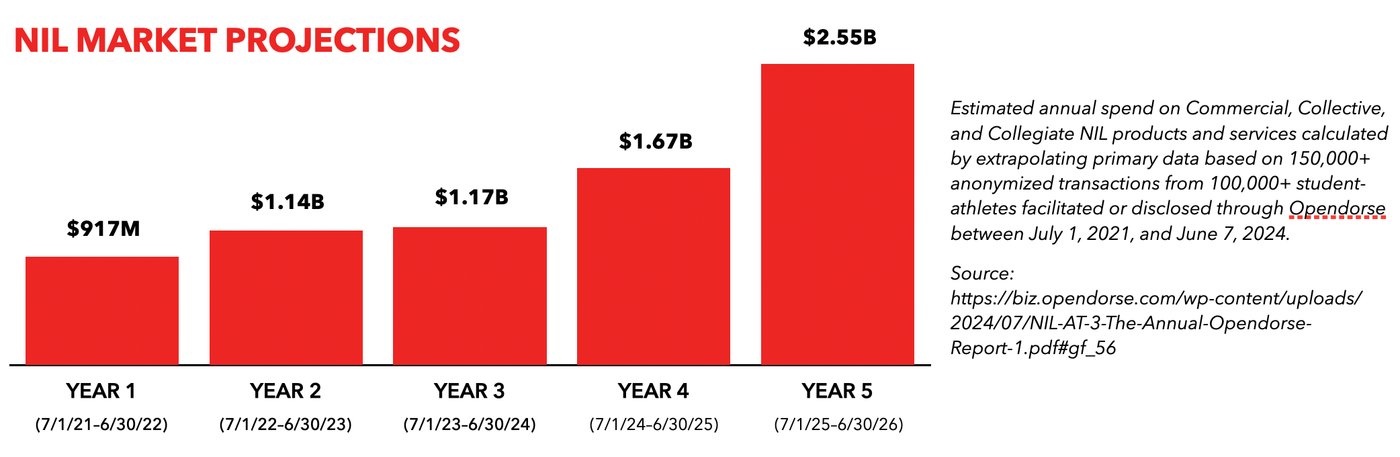
“The NIL market has exploded from $917 million in 2021-22 to an expected $1.67 billion in 2024-25 – with no signs of slowing down.”
- Opendorse
What Needs to Happen Before the Settlement is Approved?
On April 7, 2025, attorneys for both sides and objectors to the settlement met in front of Judge Claudia Wilken in the Northern District of California to discuss the finalized terms and seek final approval. Judge Wilken indicated that she accepted the terms of the settlement, but two key issues still need to be addressed:
Roster limits: Judge Wilken felt that taking opportunities away from current athletes would be unfair. She suggested that all current athletes be grandfathered in, with new roster limits being implemented over time.
The effect of the settlement on future athletes: She asked that they amend the language locking in future athletes to the settlement, but rather leaving a window open for them to object to terms when they start participating in college athletics.
“Looking down the road, how institutions classify athletes is going to change. A model where athletes are considered employees is coming, and adding athletes as W-2 employees will have a dramatic impact on schools’ workers comp, health benefits, and insurance costs.”
- Andrew Allen
What Does This Mean from a Risk Management Perspective?
This question is very hard to answer in the short term, even though it could have major implications for how your athletic department approaches risk. For starters, athletes will be collecting up to $20.5 million in revenue from the school, so institutions will be required to generate new revenue streams to share with athletes to mitigate financial risk.
At HUB International, we have created an insurance program that schools can use to help address the risks associated with revenue distribution, and ease the burden on alumni and supporters to fund the program year over year.
Looking down the road, how institutions classify athletes is going to change. A model where athletes are considered employees is coming, and adding athletes as W-2 employees will have a dramatic impact on schools’ workers comp, health benefits, and insurance costs.
There are also going to be further legal challenges to the settlement in regards to Title IX, employment status, roster limits, and how the current settlement will affect future athletes. This will result in additional legal risks and costs.
Additional resources may also be needed to help maintain compliance. It is a good idea to be in frequent contact with your compliance team and Title IX coordinator in your athletic department.
How Do I Stay Up to Date?
Both parties are expected to be back in front of Judge Wilken in the coming months with revised terms. Athletic departments are already preparing for the settlement terms to take effect. News about the settlement seems to break every day. Here are a few helpful resources you can follow to stay up to date and prepare your institution to be compliant and resilient in times of change.
Mit Winter
x.com/WinterSportsLaw
Mit is an attorney at Kennyhertz Perry LLC in Kansas City and an expert in sports law. He was recently named one of the top 70 people in the NIL space.
Jason Belzer
x.com/JasonBelzer
Jason is the Co-founder and CEO of Student Athlete NIL (SANIL) and Co-founder of AthleticDirectorU. He is a leading voice on NIL and the business of college athletics.
Ross Dellenger
x.com/RossDellenger
Ross is a reporter for Yahoo Sports and the leading media source on the House settlement.
Jason Montgomery
www.huschblackwell.com/professionals/jason-montgomery
Jason is a former NCAA investigator and now an attorney at Husch Blackwell. He consults with many programs on NCAA compliance issues.
28https://caselaw.findlaw.com/court/us-dis-crt-n-d-cal/2140891.html
29https://niledu.substack.com/p/why-nils-fair-market-value-is-challenging?utm_campaign=post&utm_medium=web
30https://sports.yahoo.com/new-college-sports-roster-limits-revealed-as-house-settlement-expands-scholarship-numbers-210542040.html