By Dr. Jolene Morse
Higher education leaders spend a great deal of time thinking about risk. Cybersecurity, regulatory compliance, financial sustainability, student safety, reputational damage, and workforce pressures dominate board agendas. These risks shape assurance, governance, and strategy.
Yet some of the most significant risks facing institutions arise from a less obvious source: decisions made with the very best of intentions.
This presents a paradox. Initiatives perceived as high risk are typically subjected to rigorous challenges. Those framed as unquestionably good—improving student well-being, advancing equity, embracing innovation, or expanding access—often receive less scrutiny because their purpose feels self-evidently right.
We don’t fail to consider risk—we think about it the wrong way.
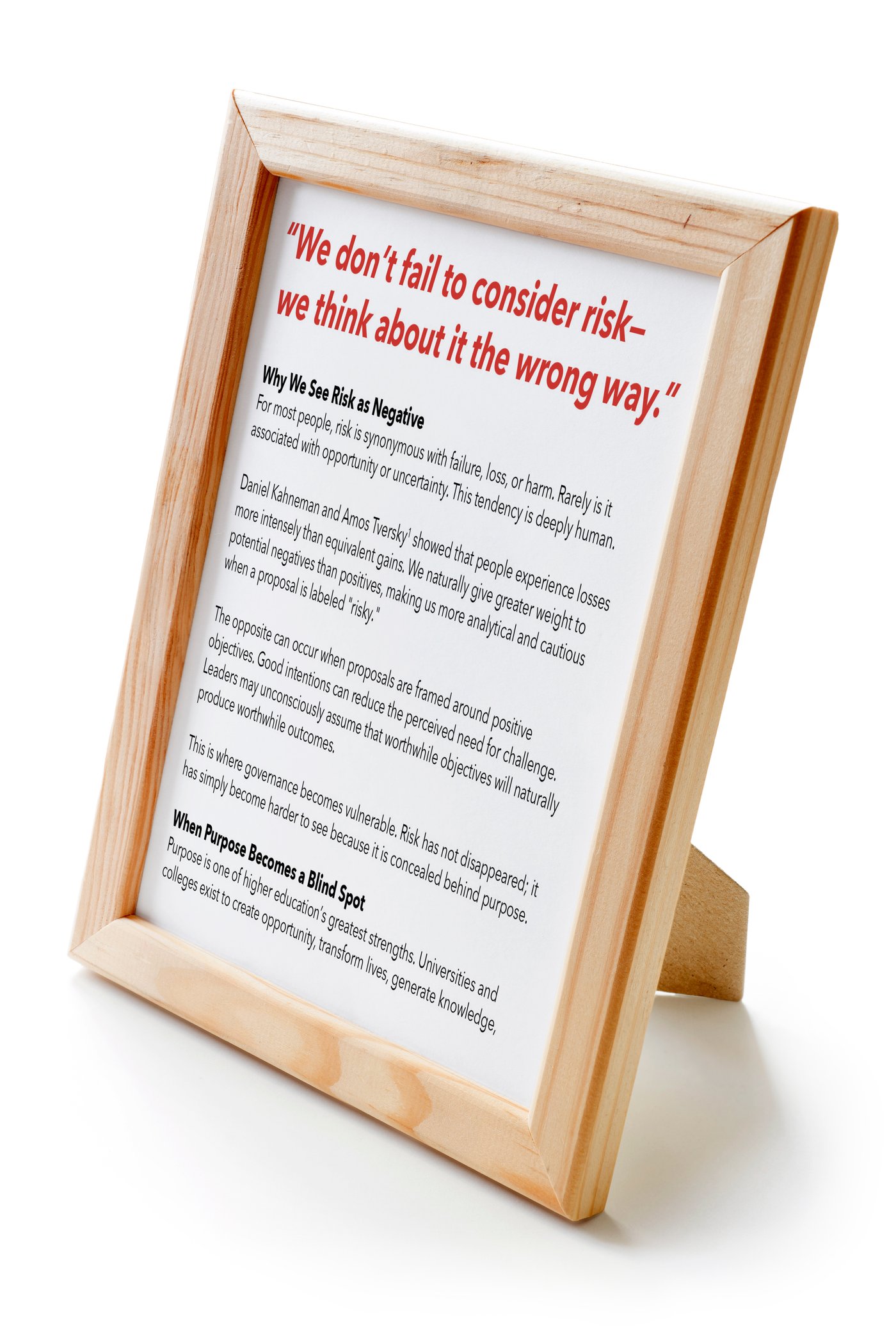
“We don’t fail to consider risk—we think about it the wrong way.”
Why We See Risk as Negative
For most people, risk is synonymous with failure, loss, or harm. Rarely is it associated with opportunity or uncertainty. This tendency is deeply human.
Daniel Kahneman and Amos Tversky1 showed that people experience losses more intensely than equivalent gains. We naturally give greater weight to potential negatives than positives, making us more analytical and cautious when a proposal is labeled "risky."
The opposite can occur when proposals are framed around positive objectives. Good intentions can reduce the perceived need for challenge. Leaders may unconsciously assume that worthwhile objectives will naturally produce worthwhile outcomes.
This is where governance becomes vulnerable. Risk has not disappeared; it has simply become harder to see because it is concealed behind purpose.
When Purpose Becomes a Blind Spot
Purpose is one of higher education’s greatest strengths. Universities and colleges exist to create opportunity, transform lives, generate knowledge, and contribute to society. But purpose can also create blind spots.
When an initiative aligns strongly with institutional values, questioning it can feel uncomfortable. Challenging the implementation pathway may be interpreted as opposing student well-being, equity, innovation, or social impact itself. As a result, governance discussions can shift from “Should we?” to “How quickly can we?” and from “What unintended consequences might this create?” to “What problem will this solve?”
It is in the space between intention and consequence that governance risks emerge.
The Most Important Governance Question
Traditional risk management often begins with the question: What could go wrong? It is an important question, but it is often incomplete.
When leaders ask what could go wrong, the focus naturally turns toward threats, controls, and mitigation. That is useful, but it may not fully expose the risks that arise from assumptions, optimism, urgency, or moral confidence.
A more powerful governance question may be: What consequences might emerge precisely because we believe this is the right thing to do?
This question changes the discussion. It shifts attention away from intentions and toward outcomes. It encourages leaders to examine assumptions rather than defend aspirations. Most importantly, it acknowledges a reality overlooked in governance: good intentions do not guarantee good outcomes.
This is not an argument for cynicism. Higher education needs bold ideas, values-led leadership, and purposeful decision making. But purpose should sharpen governance, not soften it. Regardless of how worthy the objective may be, good governance requires decision makers to ask difficult questions:
Does a decision grounded in positive intent still require evidence?
Would a values-aligned proposal still require challenge?
Might a popular initiative still require disciplined oversight?
Many organizational failures do not begin with reckless choices. They begin with decisions that seem sensible, ethical, necessary, or urgent at the time. The problem was not the intention. The problem was the absence of sufficient challenge.
Reframing Risk

Institutions need to reframe risk. Mature organizations understand that risk is neither positive nor negative; it’s uncertainty. Every initiative introduces possibilities that may help or hinder objectives, and each action produces intended and unintended consequences.
Governance is not designed to determine whether an initiative is inherently good or bad, nor can it eliminate uncertainty. Its purpose is to improve the quality of decision making by ensuring that assumptions are tested, evidence is examined, and diverse perspectives are considered before decisions are made.
This means testing assumptions, encouraging constructive dissent, exploring second-order impacts, and creating environments where challenge is viewed as a contribution rather than an obstacle. This is the essence of mature risk thinking: not avoiding risk, but understanding it well enough to make better decisions.
In practice, the most effective boards and executive teams are not those that ask the most questions about proposals that already appear dangerous. They are those that ask equally challenging questions about the proposals everyone already supports.

“Many organizational failures do not begin with reckless choices.”
Building Better Decision Governance
This requires a shift from risk management to decision governance. Risk management asks whether risks have been identified, assessed, and mitigated. Decision governance asks whether the decision itself has been sufficiently tested.
It asks:
What assumptions are we treating as facts?
Who may be unintentionally disadvantaged?
What second-order impacts could emerge?
What evidence would cause us to reconsider?
Are we mistaking alignment with values for assurance of outcomes?
Have we created enough space for dissenting views?
These questions strengthen progress, not slow it. They help institutions pursue innovation, inclusion, well-being, and transformation with greater confidence because decisions have been tested before implementation.
They also protect leaders from one of the most common governance traps: confusing consensus with rigor. A room full of agreement may signal alignment; however, it may also signal that the right questions have not yet been asked.
Beyond Good Intentions
Higher education faces increasing complexity, and this requires leaders to make consequential decisions at speed. Governance must move beyond the identification of threats and focus on the quality of decision making itself.
Good intentions matter. But they should never become a substitute for critical thinking. The decisions that deserve the greatest scrutiny are not always the ones that appear dangerous. Sometimes they are the ones that appear unquestionably good. Because hidden consequences rarely emerge from bad intentions. They emerge when good intentions go unchallenged.
https://www.ebsco.com/research-starters/business-and-management/prospect-theory